

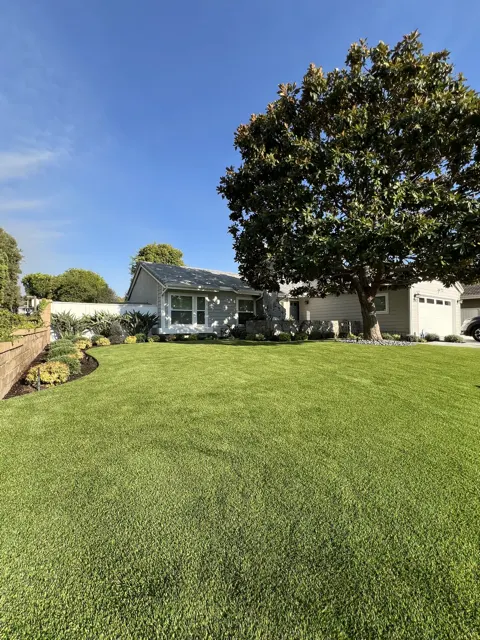
There’s no honest single price for artificial grass, because no two yards need the same work. A flat backyard with an open gate and a sloped front yard with a narrow side path can be the same size and still price very differently.
This article won’t give you a number. It explains what goes into one, so a quote makes sense when you get it and you can compare two of them fairly.
Why does yard size matter, and why isn’t it the whole story?
Size sets the starting point. More square feet means more turf, more base material, and more infill.
Shape matters too. Turf comes off a roll, so a yard full of curves, trees, and planters takes more cutting and more seams than a simple rectangle. A careful installer lays the turf to keep seams out of sight, even if that uses more material. One customer noticed the difference after collecting eight estimates:
“even though Scotts wasn’t the cheapest (because they use quality materials) unlike some of the other guys, they use more turf to minimize any seams (which I still can’t see any) unlike other companies that will quote you the minimum square footage, and piece your lawn together with unsightly seams.”
Joseph D, via Google
What does tear-out include?
Before any turf goes down, the old yard comes out. That means the lawn, the roots, and the debris, all hauled away. We also cap the irrigation under the new turf so nothing leaks into the base later.
A yard with trees, shrubs, old concrete, or rock to remove takes longer than a yard of plain grass. Ask whether removal and haul-away are in the quote, because they aren’t always.
Why does base prep change the price so much?
The base is what you’re really paying for. We lay Class II road base, grade it so water drains, and compact it with a plate compactor. That layer decides whether the turf stays flat for decades or starts to dip in the first year.
Our standard base is 4 inches deep. Wet clay is different: we dig out more of the native soil and replace it with base, which can take the base as deep as 8 inches when the soil is in poor shape. That extra digging and material raises the price, and it’s one reason no two projects cost the same.
A level yard with firm soil needs less work than a sloped yard or one with low spots that hold water. Leveling a slope or building up a low area adds material and labor, and it’s the last place you want an installer to cut corners.
Pet areas get the same base, plus a thin layer of OdorZorb, a zeolite, spread on top of it to help with urine odor.
Does drainage add to the cost?
Sometimes. Most yards drain fine once the base is graded, since water passes through the turf’s backing and follows the grade. A yard that already floods, sits lower than the house, or collects runoff from a neighbor may need more than a grade. If the yard isn’t draining properly and we can’t direct the water away from the house, we install a drainage system.
Pet areas always get a drainage grade, because urine needs somewhere to go. That’s part of what makes a pet turf system different from a front lawn.
How does your choice of turf affect the price?
Turf varies, with different pile heights, densities, blade shapes, and backings. A fully permeable backing lets water through across its whole surface, while a standard backing drains through rows of small holes. The two are priced differently, and we’ll tell you which one suits your yard. A soft, dense lawn for kids to play on, a pet-rated turf for dogs, and a short putting surface are different products at different prices. We show the options in person at the estimate, so you can feel them before you choose. The turf we install carries a 25-year manufacturer warranty.
Infill is part of the choice too. Sand works for most lawns. For pets, antimicrobial infill helps hold odor down near the backing, where residue collects.
What else can show up on a quote?
A few things that are easy to miss when you compare:
- Access. A backyard reached only through a narrow side gate means more work moving material by hand. One customer wrote that Chase “gave us a realistic overview of the job (we have a difficult to access back yard).”
- Borders and curbing. Concrete mow curbs, pavers, and flagstone all need careful cuts where the turf meets them. Checkerboard driveways and turf ribbons between pavers take a lot of cutting.
- Gopher protection. If the crew finds gopher activity, a wire mesh layer helps keep them out. One Yelp reviewer said Chase spotted gopher tracks during excavation and recommended the mesh.
- Extras. A putting green, new plants, or drip-line repairs around the turf all add to the job.
How do you compare two artificial grass quotes?
Line them up item by item. When one quote is much lower, check what it leaves out before you find out after the install. Ask each installer:
- Is tear-out and haul-away included?
- What base material do you use, and how deep?
- How do you compact it?
- Which way will the yard drain?
- What infill goes in, and how much?
- How are the seams joined, and how are the edges secured?
- What does the turf warranty cover, and what do you guarantee on the work?
- How many days will the install take?
Most of our installs take two to three days. A customer who compared several bids summed up how they chose:
“they were not the cheapest bid, not the most expensive bid. The combination of product quality, reliability, knowledge and price made our decision.”
Gordon G., via Yelp
Can you finance artificial grass?
Yes. We offer 0% financing through Synchrony for 18 months, and longer terms through Lion Financial, up to 20 years. Ask about both at your estimate.
How do you get a real number for your yard?
Start with the estimate form below. Tell us the service, the rough size, and your ZIP. It takes about 30 seconds. The owner follows up with a realistic range for your yard, then confirms exact numbers at a free on-site estimate.
We install across Orange County and the Inland Empire. To see how an install goes from tear-out to walkthrough, read about our artificial grass installation process.