

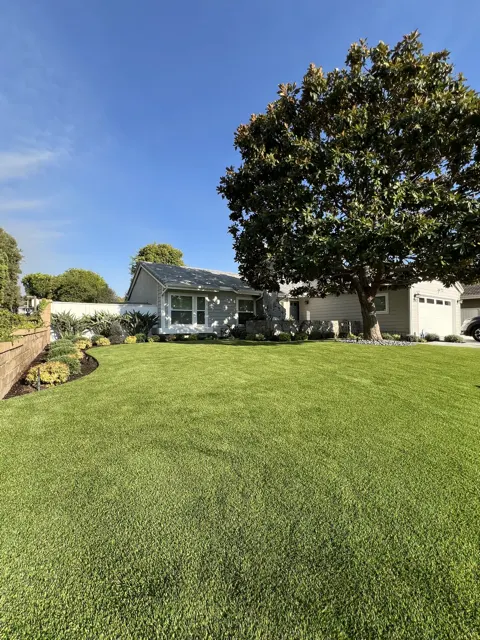
If you live in a planned community in Orange County or the Inland Empire, you need to know whether the HOA allows artificial grass before price even matters. In California, the short answer is that an HOA can’t ban it, but it can make you ask first.
This is a plain-English summary of the two sections of state law that matter, and how to put together an application that gets approved. It isn’t legal advice. Your CC&Rs and your association’s rules are the documents that apply to your home.
Can an HOA ban artificial grass in California?
No. California Civil Code section 4735 makes any HOA rule void and unenforceable if it “prohibits, or includes conditions that have the effect of prohibiting, the use of artificial turf or any other synthetic surface that resembles grass.” AB 786 added artificial turf to the law, effective October 11, 2015.
The phrase “have the effect of prohibiting” matters. An HOA can’t get around the law by writing rules so strict that no real product could meet them. A rule that only allows turf nobody makes works the same as a ban, and the statute treats it that way.
The same section protects low water-using plants used to replace an existing lawn, so drought-tolerant landscaping gets the same treatment.
What can an HOA still require?
The law lets an HOA apply the landscaping rules in its governing documents, as long as those rules fully conform with the ban on prohibiting turf. In practice, that usually means an architectural application before work starts, and standards for how the finished yard looks, such as borders, edging, and how the turf meets planting beds.
In South County planned communities like Ladera Ranch, Coto de Caza, and Aliso Viejo, expect an architectural application before any front-yard change. Most committees want to see the product and a plan, not just a description.
How does the HOA approval process work?
California Civil Code section 4765 sets the ground rules whenever an HOA requires approval for a change to your property. The association must have a fair, reasonable, and expeditious procedure with prompt deadlines and a stated maximum response time. Its decision has to be made in good faith and can’t be unreasonable, arbitrary, or capricious.
A few more protections come with it:
- Decisions must be in writing. If the HOA says no, the written decision has to explain why and describe how to ask for reconsideration.
- You can ask the board to reconsider. A denied applicant is entitled to reconsideration by the board at an open meeting.
- The HOA has to publish its rules. Every year, the association must tell members which changes need approval and how the review process works.
What goes into an application that gets approved?
Committees approve what they can see and understand. A strong artificial grass application usually includes:
- The manufacturer’s spec sheet for the exact turf, with color, pile height, and warranty.
- A physical sample, since color reads differently on paper than in your hand.
- Photos of the yard as it is now, from the street if it’s a front yard.
- A simple plan showing where the turf goes and what borders it, like pavers, curbing, or planting beds.
- Your installer’s details, including the contractor’s license number. Ours is CSLB #1024358.
We put together the spec sheets and samples an architectural committee asks for, and we’ll walk through a plan with you at the free estimate. Two customers mentioned it in their reviews:
“I liked that Scotts artificial grass uses products made in the USA, helps with HOA filing, and is a family-owned business, so I don’t have to worry about after-sales services.”
Stacey Hwang, via Google
“Competitive rates. Friendly service. Was very responsive when I needed HOA help. Got the job done in 2 days, which included removing trees and shrubs!”
Brian B., via Yelp
What if your HOA says no?
Start with the written decision. Section 4765 requires it to explain the reason, and the reason tells you what to fix. Often it’s something specific, like a color outside the committee’s guidelines or a missing border detail, and a revised application solves it.
If the denial reads like a blanket refusal of artificial turf, that’s where section 4735 comes in. You’re entitled to ask the board to reconsider at an open meeting. If that doesn’t resolve it, talk to an attorney who handles HOA matters before you install anything, because installing without approval can create a separate dispute.
Most applications never get that far. A complete package the first time is the fastest way through. If you’re planning turf in an HOA community anywhere in Orange County or the Inland Empire, see how we handle turf installation or start with the estimate form below. It takes about 30 seconds.