

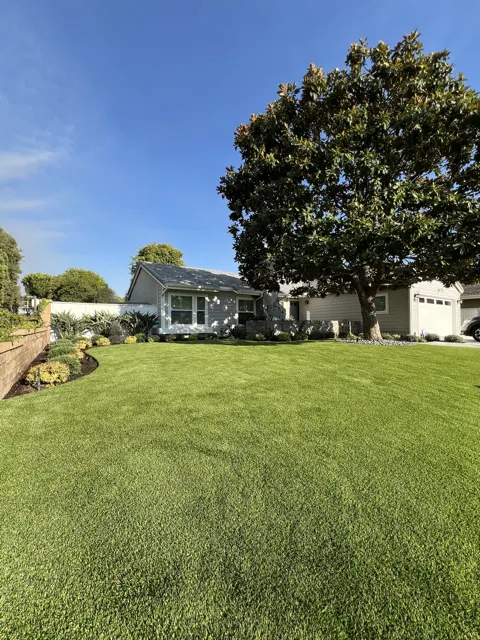
If you hose your pet turf down every weekend and the smell is back by Tuesday, the turf usually isn’t the problem. The smell is coming from underneath it, and water alone doesn’t reach the cause.
Here is how pet odor builds up in artificial grass, what zeolite infill like OdorZorb does about it, and when a yard needs more than a better cleaning routine.
Why does artificial grass smell like dog urine?
The smell comes from residue, not from the turf fibers. Urine drains through the permeable backing, but some of it dries in the infill, on the backing, and in the base below. Bacteria break down the urea in that residue into ammonia, and ammonia is the sharp smell you notice on a warm afternoon.
That is also why the smell gets worse in summer. Heat speeds up the bacteria, and a hot turf surface lifts the odor into the air right where people sit. A pet area that seemed fine in April can smell like a kennel by August.
Two things make it worse:
- Drainage that stalls. If the base under the turf was never graded or compacted properly, liquid sits in low spots instead of moving down and away. Every trip outside adds to the same spot.
- The favorite corner. Dogs pick a spot and stick with it. One small patch of turf can take most of the load for years.
Why doesn’t hosing it down fix the smell?
Hosing dilutes residue at the surface and pushes some of it deeper, but water doesn’t break it down. Whatever settles in the infill and the base is still there, still feeding bacteria. Fragrance sprays work the same way. They cover the smell for a day or two, and it comes back on the first hot afternoon.
Rinsing still matters. It keeps fresh urine from drying on the fibers, and it’s the easiest habit to keep. It just isn’t a fix on its own. On the spots the dogs use most, PE-51 enzyme spray does more than water, because the enzymes break down the organic residue instead of moving it around.
What is OdorZorb, and how does it work?
OdorZorb is a pet turf infill made by ZeoFill from natural zeolite, a porous mineral. Zeolite’s structure carries a negative charge that attracts and holds ammonium, the positively charged compound urine breaks down into. So instead of covering the smell, the infill holds its source down in the turf, below the fibers.
ZeoFill describes OdorZorb as granules that “absorb and lock in odors.” The company makes further claims about how long that lasts, and you can read those on ZeoFill’s OdorZorb page. We would rather point you there than repeat numbers we haven’t measured ourselves.
Infill is one part of the system. Zeolite can hold ammonium, but it can’t fix a base that holds water or a backing that doesn’t drain. That is why we build odor control into the install, starting with the grade.
Where does the infill go?
We brush infill down into the turf so it settles between the fibers, close to the backing. That placement matters for odor, since the backing is where urine residue collects. On a Scotts pet system, OdorZorb sits over a fully permeable backing and a graded, compacted base built to move liquid down and away from the house.
A pet turf install goes in this order:
- Drainage grade. We shape the yard so liquid moves away from the house and never settles in low spots.
- Compacted base. We lay a stable, permeable base and compact it, so active dogs don’t create soft zones or puddles.
- Turf and OdorZorb infill. We fit fully permeable pet turf over the base, then brush the infill down to where odor starts.
- Secure seams and edges. We bond seams with commercial-grade tape and adhesive, then nail and tuck the edges to help prevent dogs from lifting or digging underneath the turf.
When does a yard need a deep clean or new infill?
If the smell comes back within a day or two of a thorough rinse, the residue is below the surface and a routine won’t catch up. At that point the yard needs a professional deep clean that reaches the infill and backing, and often fresh infill brushed back into the turf.
Other signs it’s time:
- Water pools or drains slowly after you rinse.
- The infill has thinned out, and you can see backing between flattened fibers.
- The turf was never built for pets, with no permeable backing or no graded base underneath.
One of our customers with two big dogs wrote this on Yelp:
“Very happy with results. I needed new infill to manage smell of dog urine (I have 2 dogs, 105lbs & 55lbs). I got great recommendations for maintenance. I was especially happy with value. Very reasonable compared to other service options.”
Carolyn T., via Yelp
Our cleaning and repair service handles this on turf any company installed. The visit starts with a diagnosis, because odor, drainage trouble, and worn-out infill can look alike from above.
What’s the best routine for a pet turf yard?
Pick up solid waste daily. Rinse the dogs’ favorite spots regularly, and more often in hot weather. Use PE-51 enzyme spray on any spot that starts to hold a smell, and brush the fibers now and then so the infill stays spread evenly. Homes with several dogs do best with professional deep cleaning on a schedule.
If you’re planning a new dog area, we settle the smell question at install: grade, base, backing, then infill. If your turf already smells, the fix starts with finding out where the residue is sitting. Either way, the estimate form below takes about 30 seconds, and the owner will follow up with a realistic range.